Materials & Steel
Does an outdoor stainless steel shower last by the sea?
Yes, if it is AISI 316 and the surface has been sealed well. Salt attacks wherever it finds an opening: here is what happens and what actually counts.
· 2 min read
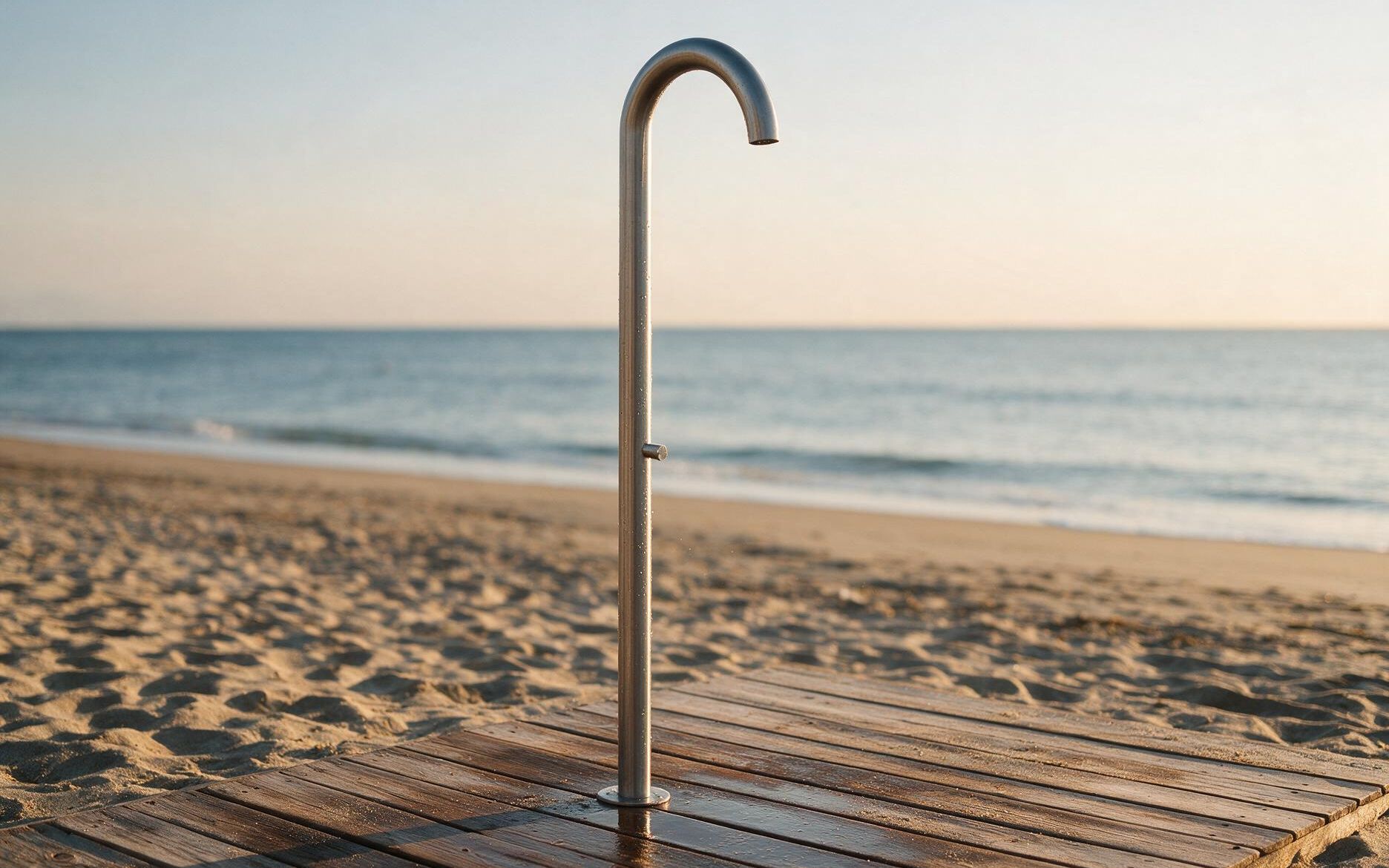
Yes, if it is AISI 316 stainless steel and its surface was sealed well in the workshop. Two hundred metres from the sea, marine steel is not a choice. It is the only one that holds. Our testing ground: Viareggio’s seafront beach clubs, where a shower spends summer under salt, sand and sun.
What attacks steel near the sea
It is not the water, it is the salt. Salt air deposits chlorides on the surface and, wherever it finds a micro-opening, triggers pitting corrosion: it starts at an invisible point and spreads. On the wrong steel, a few winters are enough.
Why AISI 316 and not 304
Between AISI 304 and AISI 316 there are a few percentage points of molybdenum. That small amount is what stops pitting corrosion. 316 costs more and is harder to work: it slows down every stage of production, and almost nobody chooses it unless they have to. Since 1999 we have never used anything else, and the steel we work is exclusively European-made.
The stage that decides everything: the surface
Raw steel has a natural porosity, microscopic openings where corrosion can take hold. That is why polishing is the stage the customer never sees and the one that matters most: the surface is polished with progressively finer abrasive grits and then with brushing machines, until nothing is left open. A column that holds up by the sea is a column sealed well, even before it is painted well.
And inside?
The internal bodies and mechanical parts are AISI 316 too, machined from solid on CNC machining centres. Where the industry uses brass, here there is the same steel as outside: fewer joints, fewer points where something can give way.
What to do to make it last
Very little. A rinse with fresh water after periods of heavy exposure to salt spray removes the chlorides before they settle. No abrasive sponges on polished finishes. For the rest, the steel does its job: after ten winters twenty metres from the sea, we know what it does when no one is watching anymore.